| Record Information |
|---|
| Version | 2.0 |
|---|
| Creation Date | 2014-09-11 05:20:13 UTC |
|---|
| Update Date | 2014-12-24 20:26:58 UTC |
|---|
| Accession Number | T3D4872 |
|---|
| Identification |
|---|
| Common Name | Tartaric acid |
|---|
| Class | Small Molecule |
|---|
| Description | Tartaric acid is a white crystalline organic acid. It occurs naturally in many plants, particularly grapes and tamarinds, and is one of the main acids found in wine. It is added to other foods to give a sour taste, and is used as an antioxidant. Salts of tartaric acid are known as tartrates. It is a dihydroxy derivative of dicarboxylic acid. Tartaric acid is a muscle toxin, which works by inhibiting the production of malic acid, and in high doses causes paralysis and death. The minimum recorded fatal dose for a human is about 12 grams. In spite of that, it is included in many foods, especially sour-tasting sweets. As a food additive, tartaric acid is used as an antioxidant with E number E334, tartrates are other additives serving as antioxidants or emulsifiers. Naturally-occurring tartaric acid is chiral, meaning that it has molecules that are non-superimposable on their mirror-images. It is a useful raw material in organic chemistry for the synthesis of other chiral molecules. The naturally occurring form of the acid is L-(+)-tartaric acid or dextrotartaric acid. The mirror-image (enantiomeric) form, levotartaric acid or D-(-)-tartaric acid, and the achiral form, mesotartaric acid, can be made artificially. Tartarate is believed to play a role in inhibiting kidney stone formation. Most tartarate that is consumed by humans is metabolized by bacteria in the gastrointestinal tract -- primarily in the large instestine. Only about 15-20% of consumed tartaric acid is secreted in the urine unchanged. |
|---|
| Compound Type | - Food Additive
- Food Toxin
- Household Toxin
- Industrial/Workplace Toxin
- Metabolite
- Natural Compound
- Organic Compound
- Plant Toxin
|
|---|
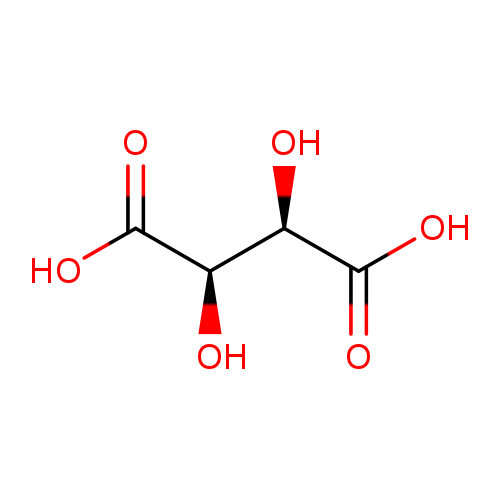
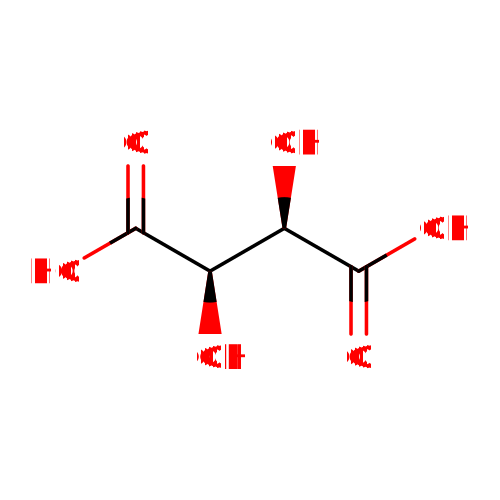
| Chemical Structure | |
|---|
| Synonyms | | Synonym | | (+)-(2R,3R)-Tartaric acid | | (+)-tartarate | | (+)-tartaric acid | | (1R,2R)-1,2-Dihydroxyethane-1,2-dicarboxylic acid | | (2R,3R)-2,3-dihydroxybutanedioate | | (2R,3R)-2,3-dihydroxybutanedioic acid | | (2R,3R)-2,3-dihydroxysuccinic acid | | (2R,3R)-2,3-tartaric acid | | (2R,3R)-Tartarate | | (2R,3R)-Tartaric acid | | (R,R)-(+)-tartaric acid | | (R,R)-tartarate | | (R,R)-tartaric acid | | (R,R)-tartrate | | 1,2-Dihydroxyethane-1,2-dicarboxylic acid | | 2,3-Dihydroxy-succinate | | 2,3-Dihydroxy-succinic acid | | 2,3-Dihydroxybutanedioate | | 2,3-Dihydroxybutanedioic acid | | 2,3-Dihydroxysuccinic acid | | D-a,b-Dihydroxysuccinic acid | | D-Tartaric acid | | Dextrotartaric acid | | L(+)-Tartaric acid | | L-(+)-Tartaric acid | | L-Tartarate | | L-Tartaric acid | | L-Threaric acid | | Natural tartaric acid | | Rechtsweinsaeure | | TAR | | Tartarate | | Tartrate | | Threaric acid | | TLA | | Weinsaeure |
|
|---|
| Chemical Formula | C4H6O6 |
|---|
| Average Molecular Mass | 150.087 g/mol |
|---|
| Monoisotopic Mass | 150.016 g/mol |
|---|
| CAS Registry Number | 87-69-4 |
|---|
| IUPAC Name | (2R,3R)-2,3-dihydroxybutanedioic acid |
|---|
| Traditional Name | L(+)-tartaric acid |
|---|
| SMILES | [H][C@](O)(C(O)=O)[C@@]([H])(O)C(O)=O |
|---|
| InChI Identifier | InChI=1S/C4H6O6/c5-1(3(7)8)2(6)4(9)10/h1-2,5-6H,(H,7,8)(H,9,10)/t1-,2-/m1/s1 |
|---|
| InChI Key | InChIKey=FEWJPZIEWOKRBE-JCYAYHJZSA-N |
|---|
| Chemical Taxonomy |
|---|
| Description | belongs to the class of organic compounds known as sugar acids and derivatives. Sugar acids and derivatives are compounds containing a saccharide unit which bears a carboxylic acid group. |
|---|
| Kingdom | Organic compounds |
|---|
| Super Class | Organic oxygen compounds |
|---|
| Class | Organooxygen compounds |
|---|
| Sub Class | Carbohydrates and carbohydrate conjugates |
|---|
| Direct Parent | Sugar acids and derivatives |
|---|
| Alternative Parents | |
|---|
| Substituents | - Sugar acid
- Short-chain hydroxy acid
- Beta-hydroxy acid
- Fatty acid
- Monosaccharide
- Hydroxy acid
- Dicarboxylic acid or derivatives
- Alpha-hydroxy acid
- Secondary alcohol
- 1,2-diol
- Carboxylic acid
- Carboxylic acid derivative
- Organic oxide
- Hydrocarbon derivative
- Carbonyl group
- Alcohol
- Aliphatic acyclic compound
|
|---|
| Molecular Framework | Aliphatic acyclic compounds |
|---|
| External Descriptors | |
|---|
| Biological Properties |
|---|
| Status | Detected and Not Quantified |
|---|
| Origin | Exogenous |
|---|
| Cellular Locations | |
|---|
| Biofluid Locations | Not Available |
|---|
| Tissue Locations | - Adipose Tissue
- Platelet
- Prostate
|
|---|
| Pathways | Not Available |
|---|
| Applications | Not Available |
|---|
| Biological Roles | Not Available |
|---|
| Chemical Roles | Not Available |
|---|
| Physical Properties |
|---|
| State | Solid |
|---|
| Appearance | White powder. |
|---|
| Experimental Properties | | Property | Value |
|---|
| Melting Point | 169 °C | | Boiling Point | Not Available | | Solubility | 582 mg/mL at 20 °C | | LogP | Not Available |
|
|---|
| Predicted Properties | |
|---|
| Spectra |
|---|
| Spectra | | Spectrum Type | Description | Splash Key | Deposition Date | View |
|---|
| MS | Mass Spectrum (Electron Ionization) | splash10-056r-9000000000-16517a02beb9427ceaff | 2019-05-16 | View Spectrum |
|
|---|
| Toxicity Profile |
|---|
| Route of Exposure | Not Available |
|---|
| Mechanism of Toxicity | Not Available |
|---|
| Metabolism | Not Available |
|---|
| Toxicity Values | Not Available |
|---|
| Lethal Dose | Not Available |
|---|
| Carcinogenicity (IARC Classification) | No indication of carcinogenicity to humans (not listed by IARC). |
|---|
| Uses/Sources | Not Available |
|---|
| Minimum Risk Level | Not Available |
|---|
| Health Effects | Not Available |
|---|
| Symptoms | Not Available |
|---|
| Treatment | Not Available |
|---|
| Normal Concentrations |
|---|
| Not Available |
|---|
| Abnormal Concentrations |
|---|
| Not Available |
|---|
| External Links |
|---|
| DrugBank ID | Not Available |
|---|
| HMDB ID | HMDB00956 |
|---|
| PubChem Compound ID | 444305 |
|---|
| ChEMBL ID | CHEMBL1236315 |
|---|
| ChemSpider ID | 392277 |
|---|
| KEGG ID | C00898 |
|---|
| UniProt ID | Not Available |
|---|
| OMIM ID | |
|---|
| ChEBI ID | 15671 |
|---|
| BioCyc ID | Not Available |
|---|
| CTD ID | Not Available |
|---|
| Stitch ID | Not Available |
|---|
| PDB ID | TLA |
|---|
| ACToR ID | Not Available |
|---|
| Wikipedia Link | Tartaric acid |
|---|
| References |
|---|
| Synthesis Reference | Milas, N. A.; Terry, Ethel M. Oxidation of fumaric and of maleic acids to tartaric acid. Journal of the American Chemical Society (1925), 47 1412-8. |
|---|
| MSDS | Link |
|---|
| General References | - Petrarulo M, Marangella M, Bianco O, Linari F: Ion-chromatographic determination of L-tartrate in urine samples. Clin Chem. 1991 Jan;37(1):90-3. [1988215 ]
- Lord RS, Burdette CK, Bralley JA: Significance of urinary tartaric acid. Clin Chem. 2005 Mar;51(3):672-3. [15738524 ]
- Sreekumar A, Poisson LM, Rajendiran TM, Khan AP, Cao Q, Yu J, Laxman B, Mehra R, Lonigro RJ, Li Y, Nyati MK, Ahsan A, Kalyana-Sundaram S, Han B, Cao X, Byun J, Omenn GS, Ghosh D, Pennathur S, Alexander DC, Berger A, Shuster JR, Wei JT, Varambally S, Beecher C, Chinnaiyan AM: Metabolomic profiles delineate potential role for sarcosine in prostate cancer progression. Nature. 2009 Feb 12;457(7231):910-4. doi: 10.1038/nature07762. [19212411 ]
|
|---|
| Gene Regulation |
|---|
| Up-Regulated Genes | Not Available |
|---|
| Down-Regulated Genes | Not Available |
|---|