| Record Information |
|---|
| Version | 2.0 |
|---|
| Creation Date | 2009-07-21 20:26:51 UTC |
|---|
| Update Date | 2014-12-24 20:25:51 UTC |
|---|
| Accession Number | T3D2784 |
|---|
| Identification |
|---|
| Common Name | Secobarbital |
|---|
| Class | Small Molecule |
|---|
| Description | Secobarbital is only found in individuals that have used or taken this drug. It is a barbiturate derivative drug. It possesses anaesthetic, anticonvulsant, sedative and hypnotic properties. In the United Kingdom, it was known as Quinalbarbitone. Secobarbital binds at a distinct binding site associated with a Cl- ionopore at the GABAA receptor, increasing the duration of time for which the Cl- ionopore is open. The post-synaptic inhibitory effect of GABA in the thalamus is, therefore, prolonged. |
|---|
| Compound Type | - Adjuvant
- Adjuvant, Anesthesia
- Amide
- Amine
- Barbiturate
- Drug
- GABA Modulator
- Hypnotic and Sedative
- Metabolite
- Organic Compound
- Synthetic Compound
|
|---|
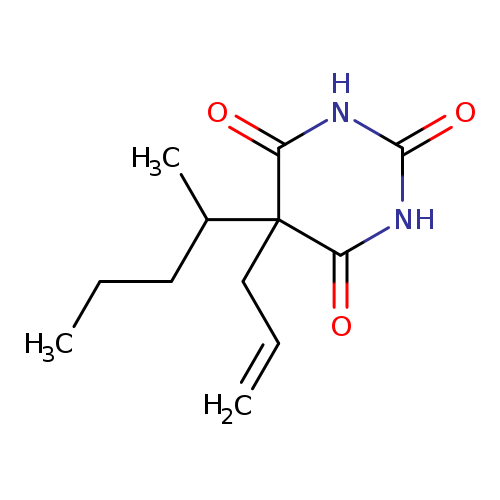
| Chemical Structure | |
|---|
| Synonyms | | Synonym | | (+-)-Secobarbital | | (+/-)-Secobarbital | | (±)-secobarbital | | 5-(1-Methylbutyl)-5-(2-propenyl)-2,4,6(1H,3H,5H)-pyrimidinetrione | | 5-Allyl-5-(1-methylbutyl)-2,4,6(1H,3H,5H)-pyrimidinetrione | | 5-allyl-5-(1-methylbutyl)barbituric acid | | 5-Allyl-5-(1-methylbutyl)pyrimidine-2,4,6(1H,3H,5H)-trione | | Quinalbarbitone | | Secobarbitale | | Secobarbitalum | | Secobarbitone | | Seconal | | Sodium quinalbarbitone | | Sodium Secobarbital |
|
|---|
| Chemical Formula | C12H18N2O3 |
|---|
| Average Molecular Mass | 238.283 g/mol |
|---|
| Monoisotopic Mass | 238.132 g/mol |
|---|
| CAS Registry Number | 76-73-3 |
|---|
| IUPAC Name | 5-(pentan-2-yl)-5-(prop-2-en-1-yl)-1,3-diazinane-2,4,6-trione |
|---|
| Traditional Name | secobarbital |
|---|
| SMILES | CCCC(C)C1(CC=C)C(O)=NC(=O)N=C1O |
|---|
| InChI Identifier | InChI=1/C12H18N2O3/c1-4-6-8(3)12(7-5-2)9(15)13-11(17)14-10(12)16/h5,8H,2,4,6-7H2,1,3H3,(H2,13,14,15,16,17) |
|---|
| InChI Key | InChIKey=KQPKPCNLIDLUMF-UHFFFAOYNA-N |
|---|
| Chemical Taxonomy |
|---|
| Description | belongs to the class of organic compounds known as barbituric acid derivatives. Barbituric acid derivatives are compounds containing a perhydropyrimidine ring substituted at C-2, -4 and -6 by oxo groups. |
|---|
| Kingdom | Organic compounds |
|---|
| Super Class | Organoheterocyclic compounds |
|---|
| Class | Diazines |
|---|
| Sub Class | Pyrimidines and pyrimidine derivatives |
|---|
| Direct Parent | Barbituric acid derivatives |
|---|
| Alternative Parents | |
|---|
| Substituents | - Barbiturate
- N-acyl urea
- Ureide
- 1,3-diazinane
- Dicarboximide
- Urea
- Carbonic acid derivative
- Carboxylic acid derivative
- Azacycle
- Organic nitrogen compound
- Organonitrogen compound
- Organooxygen compound
- Hydrocarbon derivative
- Organic oxide
- Organopnictogen compound
- Organic oxygen compound
- Carbonyl group
- Aliphatic heteromonocyclic compound
|
|---|
| Molecular Framework | Aliphatic heteromonocyclic compounds |
|---|
| External Descriptors | |
|---|
| Biological Properties |
|---|
| Status | Detected and Not Quantified |
|---|
| Origin | Exogenous |
|---|
| Cellular Locations | |
|---|
| Biofluid Locations | Not Available |
|---|
| Tissue Locations | Not Available |
|---|
| Pathways | Not Available |
|---|
| Applications | |
|---|
| Biological Roles | |
|---|
| Chemical Roles | Not Available |
|---|
| Physical Properties |
|---|
| State | Solid |
|---|
| Appearance | White powder. |
|---|
| Experimental Properties | | Property | Value |
|---|
| Melting Point | 100°C | | Boiling Point | Not Available | | Solubility | 550 mg/L | | LogP | 1.97 |
|
|---|
| Predicted Properties | |
|---|
| Spectra |
|---|
| Spectra | | Spectrum Type | Description | Splash Key | Deposition Date | View |
|---|
| GC-MS | GC-MS Spectrum - EI-B (Non-derivatized) | splash10-0006-9400000000-7060c19b726fabf79a65 | 2017-09-12 | View Spectrum | | GC-MS | GC-MS Spectrum - CI-B (Non-derivatized) | splash10-000i-0090000000-cd7b7b08df2b25a36a42 | 2017-09-12 | View Spectrum | | GC-MS | GC-MS Spectrum - EI-B (Non-derivatized) | splash10-0006-9400000000-7060c19b726fabf79a65 | 2018-05-18 | View Spectrum | | GC-MS | GC-MS Spectrum - CI-B (Non-derivatized) | splash10-000i-0090000000-cd7b7b08df2b25a36a42 | 2018-05-18 | View Spectrum | | Predicted GC-MS | Predicted GC-MS Spectrum - GC-MS (Non-derivatized) - 70eV, Positive | splash10-00fv-9640000000-bd64b937d195fac13712 | 2017-09-01 | View Spectrum | | Predicted GC-MS | Predicted GC-MS Spectrum - GC-MS (Non-derivatized) - 70eV, Positive | Not Available | 2021-10-12 | View Spectrum | | LC-MS/MS | LC-MS/MS Spectrum - LC-ESI-QFT , negative | splash10-000i-0190000000-db13804e78045568d611 | 2017-09-14 | View Spectrum | | LC-MS/MS | LC-MS/MS Spectrum - 10V, Negative | splash10-000i-0290000000-d86de671e312eea0a25a | 2021-09-20 | View Spectrum | | LC-MS/MS | LC-MS/MS Spectrum - 35V, Negative | splash10-000f-9560000000-9d9b88d1074bc4050252 | 2021-09-20 | View Spectrum | | LC-MS/MS | LC-MS/MS Spectrum - 20V, Positive | splash10-001i-0900000000-3ca3c567b6b2968e849d | 2021-09-20 | View Spectrum | | LC-MS/MS | LC-MS/MS Spectrum - 10V, Positive | splash10-001i-0900000000-66fa917cc18fa12a1e35 | 2021-09-20 | View Spectrum | | LC-MS/MS | LC-MS/MS Spectrum - 35V, Negative | splash10-000i-0190000000-db13804e78045568d611 | 2021-09-20 | View Spectrum | | Predicted LC-MS/MS | Predicted LC-MS/MS Spectrum - 10V, Positive | splash10-000i-1190000000-a32998e9d470646171bb | 2016-08-02 | View Spectrum | | Predicted LC-MS/MS | Predicted LC-MS/MS Spectrum - 20V, Positive | splash10-014i-1910000000-a7eedca671cea79ccabe | 2016-08-02 | View Spectrum | | Predicted LC-MS/MS | Predicted LC-MS/MS Spectrum - 40V, Positive | splash10-008c-9100000000-27475f9b934cbdc3e650 | 2016-08-02 | View Spectrum | | Predicted LC-MS/MS | Predicted LC-MS/MS Spectrum - 10V, Negative | splash10-0006-8960000000-6fad2b5588666b99e2fb | 2016-08-03 | View Spectrum | | Predicted LC-MS/MS | Predicted LC-MS/MS Spectrum - 20V, Negative | splash10-0006-9710000000-a3d04768b9d678771dd4 | 2016-08-03 | View Spectrum | | Predicted LC-MS/MS | Predicted LC-MS/MS Spectrum - 40V, Negative | splash10-0006-9500000000-aa08a543bafa7b7a22bc | 2016-08-03 | View Spectrum | | Predicted LC-MS/MS | Predicted LC-MS/MS Spectrum - 10V, Negative | splash10-000i-0090000000-b039560fc84cd32f1088 | 2021-09-22 | View Spectrum | | Predicted LC-MS/MS | Predicted LC-MS/MS Spectrum - 20V, Negative | splash10-0006-9000000000-91935f76c8fa79268cfc | 2021-09-22 | View Spectrum | | Predicted LC-MS/MS | Predicted LC-MS/MS Spectrum - 40V, Negative | splash10-0006-9600000000-a49a216554329721fa1b | 2021-09-22 | View Spectrum | | Predicted LC-MS/MS | Predicted LC-MS/MS Spectrum - 10V, Positive | splash10-014r-0970000000-0de765aed5fb2211edc8 | 2021-09-23 | View Spectrum | | Predicted LC-MS/MS | Predicted LC-MS/MS Spectrum - 20V, Positive | splash10-00kr-1960000000-56c18517e4df3bf96800 | 2021-09-23 | View Spectrum | | Predicted LC-MS/MS | Predicted LC-MS/MS Spectrum - 40V, Positive | splash10-0ldi-4900000000-03e38b2d7b88e080321d | 2021-09-23 | View Spectrum | | MS | Mass Spectrum (Electron Ionization) | splash10-014i-6900000000-eb3ae85faebb012ef83b | 2014-09-20 | View Spectrum | | 1D NMR | 1H NMR Spectrum (1D, 400 MHz, DMSO-d6, experimental) | Not Available | 2014-09-20 | View Spectrum |
|
|---|
| Toxicity Profile |
|---|
| Route of Exposure | Oral (1); Parenteral (1); Rectal (1). |
|---|
| Mechanism of Toxicity | Secobarbital binds at a distinct binding site associated with a Cl- ionopore at the GABAA receptor, increasing the duration of time for which the Cl- ionopore is open. The post-synaptic inhibitory effect of GABA in the thalamus is, therefore, prolonged. |
|---|
| Metabolism |
Route of Elimination: Barbiturates are metabolized primarily by the hepatic microsomal enzyme system, and the metabolic products are excreted in the urine and, less commonly, in the feces. |
|---|
| Toxicity Values | Not Available |
|---|
| Lethal Dose | Not Available |
|---|
| Carcinogenicity (IARC Classification) | No indication of carcinogenicity to humans (not listed by IARC). |
|---|
| Uses/Sources | For the Short-term treatment of intractable insomnia for patients habituated to barbiturates |
|---|
| Minimum Risk Level | Not Available |
|---|
| Health Effects | Secobarbital causes slurred speech, disorientation and "drunken" behavior. It is physically and psychologically addictive. |
|---|
| Symptoms | Symptoms of an overdose typically include sluggishness, incoordination, difficulty in thinking, slowness of speech, faulty judgment, drowsiness or coma, shallow breathing, staggering, and in severe cases coma and death. |
|---|
| Treatment | Not Available |
|---|
| Normal Concentrations |
|---|
| Not Available |
|---|
| Abnormal Concentrations |
|---|
| Not Available |
|---|
| External Links |
|---|
| DrugBank ID | DB00418 |
|---|
| HMDB ID | HMDB14562 |
|---|
| PubChem Compound ID | 5193 |
|---|
| ChEMBL ID | CHEMBL447 |
|---|
| ChemSpider ID | 5005 |
|---|
| KEGG ID | Not Available |
|---|
| UniProt ID | Not Available |
|---|
| OMIM ID | |
|---|
| ChEBI ID | 9073 |
|---|
| BioCyc ID | Not Available |
|---|
| CTD ID | Not Available |
|---|
| Stitch ID | Secobarbital |
|---|
| PDB ID | Not Available |
|---|
| ACToR ID | Not Available |
|---|
| Wikipedia Link | Secobarbital |
|---|
| References |
|---|
| Synthesis Reference | Not Available |
|---|
| MSDS | Link |
|---|
| General References | - Drugs.com [Link]
- Wikipedia. Secobarbital. Last Updated 3 October 2009. [Link]
|
|---|
| Gene Regulation |
|---|
| Up-Regulated Genes | Not Available |
|---|
| Down-Regulated Genes | Not Available |
|---|