| Record Information |
|---|
| Version | 2.0 |
|---|
| Creation Date | 2009-07-03 22:19:18 UTC |
|---|
| Update Date | 2014-12-24 20:25:40 UTC |
|---|
| Accession Number | T3D2544 |
|---|
| Identification |
|---|
| Common Name | Convulxin |
|---|
| Class | Protein |
|---|
| Description | Convulxin is a peptide toxin produced by the South American rattlesnake (Crotalus durissus terrificus). (4) |
|---|
| Compound Type | - Amide
- Amine
- Animal Toxin
- Natural Compound
- Organic Compound
- Protein
- Snake Venom
|
|---|
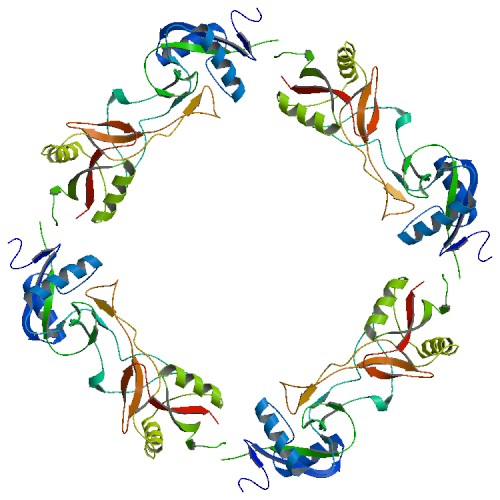
| Protein Structure |  |
|---|
| Synonyms | | Synonym | | CVX | | CVX-alpha | | Snaclec convulxin subunit alpha |
|
|---|
| Chemical Formula | Not Available |
|---|
| Average Molecular Mass | 18140.725 g/mol |
|---|
| CAS Registry Number | 37206-04-5 |
|---|
| Sequence | Not Available |
|---|
| Chemical Taxonomy |
|---|
| Description | Not Available |
|---|
| Kingdom | Organic Compounds |
|---|
| Super Class | Organic Acids |
|---|
| Class | Carboxylic Acids and Derivatives |
|---|
| Sub Class | Amino Acids, Peptides, and Analogues |
|---|
| Direct Parent | Peptides |
|---|
| Alternative Parents | Not Available |
|---|
| Substituents | Not Available |
|---|
| Molecular Framework | Not Available |
|---|
| External Descriptors | Not Available |
|---|
| Biological Properties |
|---|
| Status | Detected and Not Quantified |
|---|
| Origin | Exogenous |
|---|
| Cellular Locations | Not Available |
|---|
| Biofluid Locations | Not Available |
|---|
| Tissue Locations | Not Available |
|---|
| Pathways | Not Available |
|---|
| Applications | Not Available |
|---|
| Biological Roles | Not Available |
|---|
| Chemical Roles | Not Available |
|---|
| Physical Properties |
|---|
| State | Liquid |
|---|
| Appearance | Clear solution. |
|---|
| Experimental Properties | | Property | Value |
|---|
| Melting Point | Not Available | | Boiling Point | Not Available | | Solubility | >10 mg/mL | | LogP | Not Available |
|
|---|
| Predicted Properties | Not Available |
|---|
| Spectra |
|---|
| Spectra | | Spectrum Type | Description | Splash Key | Deposition Date | View |
|---|
|
|---|
| Toxicity Profile |
|---|
| Route of Exposure | Injection (sting/bite) (5) |
|---|
| Mechanism of Toxicity | Convulxin binds to the platelet and collagen receptor, glycoprotein VI (GPVI). This causes platelet activation in the blood forming clots and a build up of pressure, which can cause the bloodstream to burst, or the heart or brain to lose blood and result in death. (2) |
|---|
| Metabolism | Free toxin may be removed by opsonization via the reticuloendothelial system (primarily the liver and kidneys) or it may be degraded through cellular internalization via the lysosomes. Lysosomes are membrane-enclosed organelles that contain an array of digestive enzymes, including several proteases. |
|---|
| Toxicity Values | LD50: 0.262 mg/kg (Intravenous, Mouse) (6)
LD50: 0.216 mg/kg (Intraperitoneal, Mouse) (6) |
|---|
| Lethal Dose | Not Available |
|---|
| Carcinogenicity (IARC Classification) | No indication of carcinogenicity to humans (not listed by IARC). |
|---|
| Uses/Sources | Convulxin is a peptide toxin produced by the South American rattlesnake (Crotalus durissus terrificus). (4) |
|---|
| Minimum Risk Level | Not Available |
|---|
| Health Effects | Convulxin causes platelet activation in the blood forming clots and a build up of pressure. This can cause the bloodstream to burst, or the heart or brain to lose blood and result in death. (2) |
|---|
| Symptoms | Bites from snakes in the Viperidae family cause local pain, swelling, edema, skin discoloration, and ecchymosis. (1) |
|---|
| Treatment | An antivenom exists for South American rattlesnake venom. (3) |
|---|
| Normal Concentrations |
|---|
| Not Available |
|---|
| Abnormal Concentrations |
|---|
| Not Available |
|---|
| External Links |
|---|
| DrugBank ID | Not Available |
|---|
| HMDB ID | Not Available |
|---|
| PubChem Compound ID | Not Available |
|---|
| ChEMBL ID | Not Available |
|---|
| ChemSpider ID | Not Available |
|---|
| KEGG ID | Not Available |
|---|
| UniProt ID | O93426 |
|---|
| OMIM ID | |
|---|
| ChEBI ID | Not Available |
|---|
| BioCyc ID | Not Available |
|---|
| CTD ID | Not Available |
|---|
| Stitch ID | Not Available |
|---|
| PDB ID | 1UMR |
|---|
| ACToR ID | Not Available |
|---|
| Wikipedia Link | Not Available |
|---|
| References |
|---|
| Synthesis Reference | Not Available |
|---|
| MSDS | Not Available |
|---|
| General References | - Dreisbach, RH (1983). Handbook of Poisoning. Los Altos, California: Lange Medical Publications.
- The UniProt Consortium. The Universal Protein Resource (UniProt) Nucleic Acids Res. 2008;36:D190-D195.
- Wikipedia. Antivenom. Last Updated 1 July 2009. [Link]
- Wikipedia. Convulxin. Last Updated 20 February 2009. [Link]
- Wikipedia. Snake venom. Last Updated 25 July 2009. [Link]
- Thomas S, Griessel E (1999). LD50 Scores for various snakes. [Link]
|
|---|
| Gene Regulation |
|---|
| Up-Regulated Genes | Not Available |
|---|
| Down-Regulated Genes | Not Available |
|---|