| Record Information |
|---|
| Version | 2.0 |
|---|
| Creation Date | 2009-03-06 18:58:05 UTC |
|---|
| Update Date | 2014-12-24 20:21:07 UTC |
|---|
| Accession Number | T3D0103 |
|---|
| Identification |
|---|
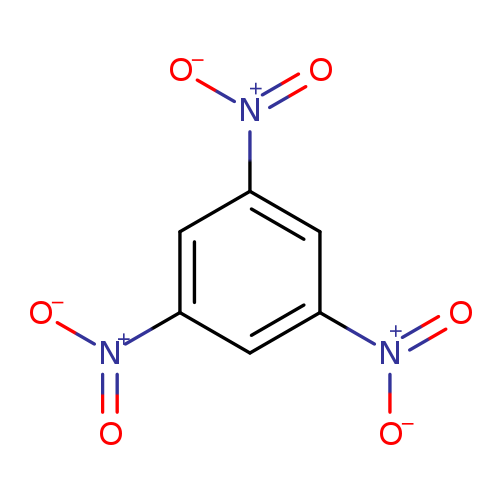
| Common Name | 1,3,5-Trinitrobenzene |
|---|
| Class | Small Molecule |
|---|
| Description | 1,3,5-Trinitrobenzene (1,3,5-TNB) is a synthetic substance that is used in explosives. (4) |
|---|
| Compound Type | - Aromatic Hydrocarbon
- Explosive Agent
- Industrial/Workplace Toxin
- Nitrite
- Organic Compound
- Synthetic Compound
|
|---|
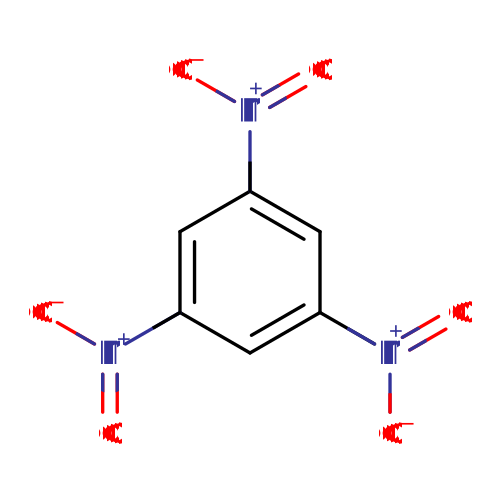
| Chemical Structure | |
|---|
| Synonyms | | Synonym | | 1,3, 5-Trinitrobenzene | | 1,3,5-Trinitrobenzol | | 2,4,6-trinitrobenzene | | Benzite | | S-trinitrobenzene | | SYM-trinitrobenzene | | Symmetric trinitrobenzene | | SYN-trinitrobenzene | | TNB | | Trinitrobenzene |
|
|---|
| Chemical Formula | C6H3N3O6 |
|---|
| Average Molecular Mass | 213.105 g/mol |
|---|
| Monoisotopic Mass | 213.002 g/mol |
|---|
| CAS Registry Number | 99-35-4 |
|---|
| IUPAC Name | 1,3,5-trinitrobenzene |
|---|
| Traditional Name | trinitrobenzene |
|---|
| SMILES | [O-][N+](=O)C1=CC(=CC(=C1)[N+]([O-])=O)[N+]([O-])=O |
|---|
| InChI Identifier | InChI=1S/C6H3N3O6/c10-7(11)4-1-5(8(12)13)3-6(2-4)9(14)15/h1-3H |
|---|
| InChI Key | InChIKey=UATJOMSPNYCXIX-UHFFFAOYSA-N |
|---|
| Chemical Taxonomy |
|---|
| Description | belongs to the class of organic compounds known as nitrobenzenes. Nitrobenzenes are compounds containing a nitrobenzene moiety, which consists of a benzene ring with a carbon bearing a nitro group. |
|---|
| Kingdom | Organic compounds |
|---|
| Super Class | Benzenoids |
|---|
| Class | Benzene and substituted derivatives |
|---|
| Sub Class | Nitrobenzenes |
|---|
| Direct Parent | Nitrobenzenes |
|---|
| Alternative Parents | |
|---|
| Substituents | - Nitrobenzene
- Nitroaromatic compound
- Organic nitro compound
- C-nitro compound
- Organic 1,3-dipolar compound
- Propargyl-type 1,3-dipolar organic compound
- Allyl-type 1,3-dipolar organic compound
- Organic oxoazanium
- Organic nitrogen compound
- Organic oxygen compound
- Organopnictogen compound
- Organic oxide
- Hydrocarbon derivative
- Organonitrogen compound
- Aromatic homomonocyclic compound
|
|---|
| Molecular Framework | Aromatic homomonocyclic compounds |
|---|
| External Descriptors | |
|---|
| Biological Properties |
|---|
| Status | Detected and Not Quantified |
|---|
| Origin | Exogenous |
|---|
| Cellular Locations | |
|---|
| Biofluid Locations | Not Available |
|---|
| Tissue Locations | Not Available |
|---|
| Pathways | Not Available |
|---|
| Applications | Not Available |
|---|
| Biological Roles | Not Available |
|---|
| Chemical Roles | |
|---|
| Physical Properties |
|---|
| State | Solid |
|---|
| Appearance | Yellow solid. |
|---|
| Experimental Properties | | Property | Value |
|---|
| Melting Point | 121.5°C | | Boiling Point | Not Available | | Solubility | 0.278 mg/mL at 15 °C [YALKOWSKY,SH & DANNENFELSER,RM (1992)] | | LogP | Not Available |
|
|---|
| Predicted Properties | |
|---|
| Spectra |
|---|
| Spectra | | Spectrum Type | Description | Splash Key | Deposition Date | View |
|---|
| Predicted GC-MS | Predicted GC-MS Spectrum - GC-MS (Non-derivatized) - 70eV, Positive | splash10-03di-0090000000-a30aa9a40b9ab37a15f6 | 2021-09-24 | View Spectrum | | Predicted GC-MS | Predicted GC-MS Spectrum - GC-MS (Non-derivatized) - 70eV, Positive | Not Available | 2021-10-12 | View Spectrum | | Predicted LC-MS/MS | Predicted LC-MS/MS Spectrum - 10V, Positive | splash10-03di-0090000000-398ffea8a5845e630c77 | 2016-08-01 | View Spectrum | | Predicted LC-MS/MS | Predicted LC-MS/MS Spectrum - 20V, Positive | splash10-0a4l-0590000000-e860cd06a78af86dc521 | 2016-08-01 | View Spectrum | | Predicted LC-MS/MS | Predicted LC-MS/MS Spectrum - 40V, Positive | splash10-0btc-0690000000-02bd0a06e80146e0ec84 | 2016-08-01 | View Spectrum | | Predicted LC-MS/MS | Predicted LC-MS/MS Spectrum - 10V, Negative | splash10-03di-0090000000-cc780cd5655f0b1ffd2a | 2016-08-03 | View Spectrum | | Predicted LC-MS/MS | Predicted LC-MS/MS Spectrum - 20V, Negative | splash10-03di-0090000000-a0c65596d90080d48193 | 2016-08-03 | View Spectrum | | Predicted LC-MS/MS | Predicted LC-MS/MS Spectrum - 40V, Negative | splash10-08fr-1190000000-885b4046ba5937ce4d6d | 2016-08-03 | View Spectrum | | MS | Mass Spectrum (Electron Ionization) | splash10-03di-9260000000-c6b318055501d919d6b7 | 2014-09-20 | View Spectrum |
|
|---|
| Toxicity Profile |
|---|
| Route of Exposure | Oral (4); inhalation (4) ; dermal (4) |
|---|
| Mechanism of Toxicity | In the red blood cell, 1,3,5-TNB induces formation of methemoglobin, leading to cyanosis. Reduction of the nitrogroup(s) of 1,3,5-TNB produces reactive nitroaromatic radical anions which redox cycle to produce other reactive species such as superoxide anion. Redox cycling of these intermediates probably causes the methemoglobinemia. 1,3,5-TNB may also exert neurotoxic effects by damaging the blood-brain barrier.(4, 1) |
|---|
| Metabolism | 1,3,5-Trinitrobenzene is absorbed via oral, inhalation, and dermal routes and is believed to penetrate the red blood cell membrane. The metabolism of 1,3,5-TNB includes both oxidative and reductive biotransformations, followed by conjugation. The main route of excretion of 1,3,5-TNB metabolites is the urine. (4) |
|---|
| Toxicity Values | LD50: 250 mg/kg (Oral, Rat) (2)
LD50: 32 mg/kg (Intravenous, Mouse) (2) |
|---|
| Lethal Dose | Not Available |
|---|
| Carcinogenicity (IARC Classification) | No indication of carcinogenicity to humans (not listed by IARC). |
|---|
| Uses/Sources | 1,3,5-Trinitrobenzene is used in explosives. Waste discharges from army ammunitions plants or other chemical manufacturers are the primary sources for release into the air, water, and soil. (4) |
|---|
| Minimum Risk Level | Not Available |
|---|
| Health Effects | Chronic exposure to 1,3,5-trinitrobenzene can cause a reduction (or loss) in the number of red blood cells (anemia). 1,3,5-TNB may also have neurotoxic effects. (4, 1) |
|---|
| Symptoms | Exposure to high concentrations of 1,3,5-trinitrobenzene can reduce the ability of blood to carry oxygen and can cause skin bluishing. Other symptoms nclude headache, nausea, and dizziness. (4) |
|---|
| Treatment | Treatment is mainly symptomatic and may include gastric lavage and/or the administration of activated charcoal. Benzodiazepine may be administered if seizures occur. If methemoglobinemia is evident, 1 to 2 mg/kg of 1% methylene blue should be administered via IV. (3) |
|---|
| Normal Concentrations |
|---|
| Not Available |
|---|
| Abnormal Concentrations |
|---|
| Not Available |
|---|
| External Links |
|---|
| DrugBank ID | Not Available |
|---|
| HMDB ID | Not Available |
|---|
| PubChem Compound ID | 7434 |
|---|
| ChEMBL ID | Not Available |
|---|
| ChemSpider ID | 13873689 |
|---|
| KEGG ID | Not Available |
|---|
| UniProt ID | Not Available |
|---|
| OMIM ID | |
|---|
| ChEBI ID | 48113 |
|---|
| BioCyc ID | Not Available |
|---|
| CTD ID | C029222 |
|---|
| Stitch ID | 1,3,5-Trinitrobenzene |
|---|
| PDB ID | Not Available |
|---|
| ACToR ID | 1437 |
|---|
| Wikipedia Link | 1,3,5-Trinitrobenzene |
|---|
| References |
|---|
| Synthesis Reference | Not Available |
|---|
| MSDS | T3D0103.pdf |
|---|
| General References | - Stair EL, Reddy G, Ritchey JW, Saliki JT, Quails CW Jr: Effects of 1,3,5-Trinitrobenzene on cytotoxicity and metabolic activity of type I astrocytes of rats. Int J Toxicol. 2005 Jan-Feb;24(1):51-7. [15981740 ]
- Lewis RJ Sr. (ed) (2004). Sax's Dangerous Properties of Industrial Materials. 11th Edition. Hoboken, NJ: Wiley-Interscience, Wiley & Sons, Inc.
- Rumack BH (2009). POISINDEX(R) Information System. Englewood, CO: Micromedex, Inc. CCIS Volume 141, edition expires Aug, 2009.
- ATSDR - Agency for Toxic Substances and Disease Registry (1995). Toxicological profile for 1,3-dinitrobenzene and 1,3,5-trinitrobenzene (1,3-DNB and 1,3,5-TNB). U.S. Public Health Service in collaboration with U.S. Environmental Protection Agency (EPA). [Link]
|
|---|
| Gene Regulation |
|---|
| Up-Regulated Genes | Not Available |
|---|
| Down-Regulated Genes | Not Available |
|---|